Among quaint fads of the 19th century, like riding
bicycles or playing board games, one sticks out like a sore thumb—the
Victorian-era obsession with seaweed. That’s right: Affluent Victorians
often spent hours painstakingly collecting, drying, and mounting these
underwater plants into decorative scrapbooks. Why seaweed?
“Part of the appeal was what a seaweed collection said about the collector.”
In Western Europe and the Americas, the 18th and 19th centuries were a
time of major cultural upheaval, as industrialization reshaped nearly
every aspect of daily life. New national holidays and improved labor
laws gave working people more time off, which they could spend at home
or enjoy by the seashore, often a quick train ride away. At the same
time, influential naturalists like John James Audubon and Charles Darwin
helped develop a popular interest in science and nature. Birdwatching
boomed; taxidermied creatures filled middle-class homes; fur and
feathers dominated fashion trends.
The shift to wage labor also helped spread the concept of leisure
time, when people could explore their personal interests and hobbies. As
the Victorian parlor or “withdrawing room” became the locus of private
life, the chaotic outside world was ordered and beautified through home
furnishings and decorative collections. Finally, improvements in
printing technology created an explosion of paper ephemera, like the
die-cut imagery explicitly designed for album-making. A generation of
scrapbookers was born.

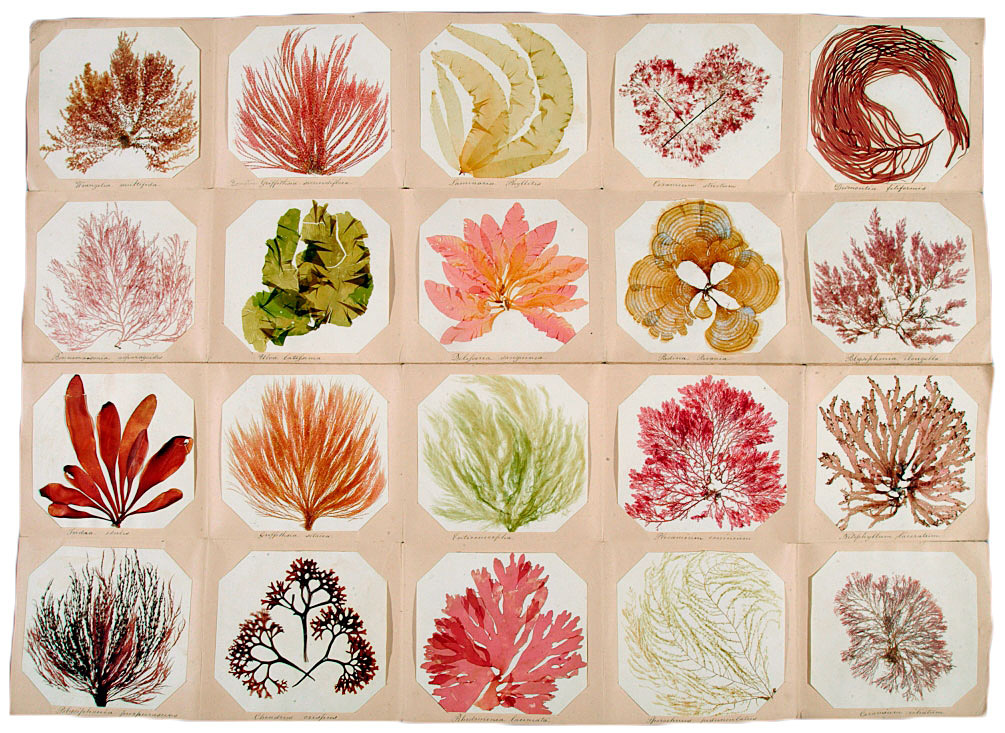
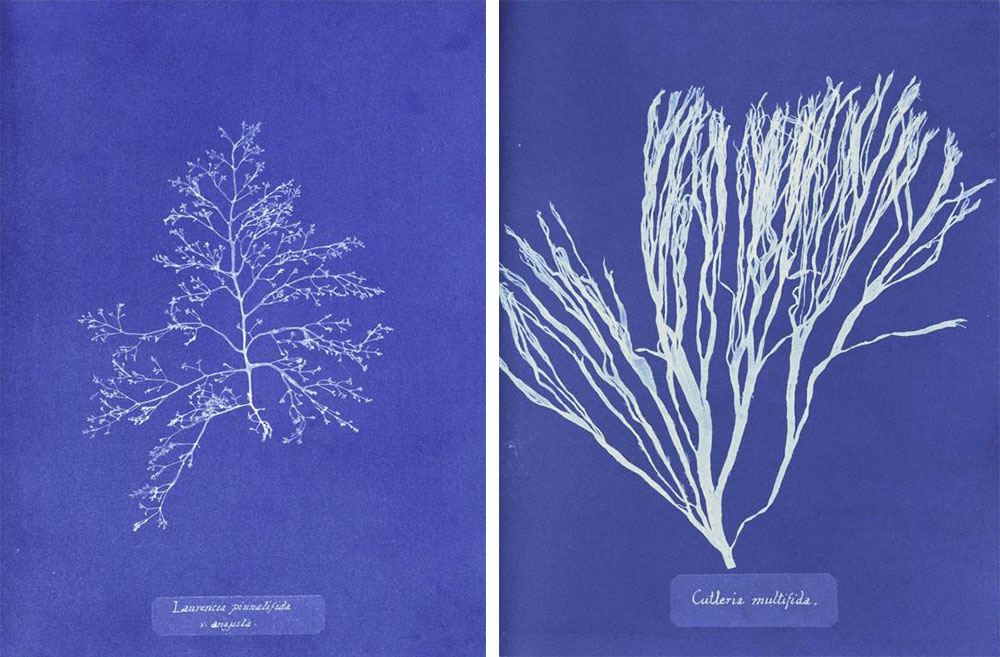
Top:
A collection of seaweed from the Jersey area of the United Kingdom,
circa 1850s. Courtesy the Natural History Museum, London. Above: Two
cyanotype prints from Anna Atkins’ “Photographs of British Algae,”
released as a series between 1843 and 1850.
Seaweed collecting embodied a cross-section of Victorian-era
pursuits, allowing people to explore nature, improve their scientific
knowledge, and create an attractive memento to decorate their homes. By
the 1840s, several books on identifying and preserving seaweed had been
published, including the series “Photographs of British Algae,”
by Anna Atkins. Atkins’ guide is considered the first-ever book of
photography, as she used cyanotype prints to document various species
(seaweed was placed onto photo-sensitive paper and exposed to light,
resulting in a negative image of the plant).
Inspired by the work of Atkins and others, amateurs all across the
U.K., Canada, and New England began tramping into tide pools to collect
their own specimens. Laura Massey, a cataloguer for rare bookseller Peter Harrington,
explains that such scientific pursuits weren’t limited to men; they
also represented a respectable pastime for women “who were not expected
to study science for its own sake, but as a social accomplishment.”
Massey began researching the world of seaweed collecting after her
firm acquired a handmade seaweed album marked “Miss Mary Carrington,”
though it’s still unclear whether the book was made for or by Ms.
Carrington. We recently spoke with Massey about the insatiable curiosity
of Victorians and their love of seaweed.

The album labelled “Miss Mary Carrington” and one of the book’s pressed seaweed samples, circa 1830.
Collectors Weekly: How did your firm acquire Mary Carrington’s album?

The
title page of W.C. Johnstone and A. Croall’s “British Seaweeds” from
1859, which was illustrated with Henry Bradbury’s nature prints.
Laura Massey: A colleague and I have a particular interest
in women’s history and in craft skills traditionally defined as
feminine, and we keep our eyes open for unusual items, such as this
album, which we purchased from another bookseller. We think that this
example came from the northeastern United States, because the blank book
in which the seaweed was arranged was published in New Haven,
Connecticut. That location makes sense, as seaweed is plentiful along
the cold, rocky shores of New England, and the region would have had a
large population of middle- and upper-class young ladies with the time
and resources to pursue aesthetic and intellectual hobbies.
This is the first seaweed album we have handled, and they seem to be
among the rarer types of albums we come across. There are several
reasons for this. Seaweed collecting wasn’t quite as popular as
mainstream hobbies—it was more technically demanding than pressing
flowers, and was restricted to regions where seaweed occurred naturally,
or to people who could travel to those regions.
I also suspect that when families were dealing with estates they
might have seen the aesthetic value in an album of fashion prints or
flowers, but perhaps not in seaweed, and discarded them more readily.
But as with other types of material, these come and go on the market,
and you might go a long time between sightings and then stumble across
two or three in a short span of time.

One
of Bradbury’s nature prints featured in Johnstone and Croall’s seaweed
guide. Developed in 1853, the process created an impression of the plant
on a lead plate, which was inked and used to make highly realistic
prints.
Collectors Weekly: How did the broader genre of scrapbooking originate?
Massey: I suppose it depends on how far back you want to
look. The argument could be made that scrapbooking is an extension of
medieval and early modern literary practices such as compiling and the
production of commonplace books. Compiling was a literary form during
the Middle Ages in which scholars selected material from established
authorities, such as the Church fathers and Aristotle, and combined them
into new books. Commonplace books were an early modern and Victorian
phenomenon in which readers recorded literary passages in their own
blank books to save and organize them for future reference. But
scrapbooking as we know it today appeared at the beginning of the 19th
century.
“The Victorian era was a more pungent time, so I suspect they wouldn’t have been as bothered by the smell.”
The rise of the middle class created a population of young, educated
women who didn’t have to do manual labor and needed edifying activities
to fill their time. At the same time, the Industrial Revolution was
making paper and books less expensive, and women had access to unprecedented numbers of magazines, newspapers, prints, and fashion plates.
Entrepreneurs saw that there was a market for volumes in which to
preserve ephemera, and most stationers probably stocked a variety of
blank books for use as journals and scrapbooks by both men and women. By
the end of the century, publishers were even producing ready-made,
color-printed, and die-stamped scraps. And certain shops, such as that
of Mary Wyatt in Torquay, England, specialized in natural souvenirs and
catered to the needs of collectors for albums and other materials.

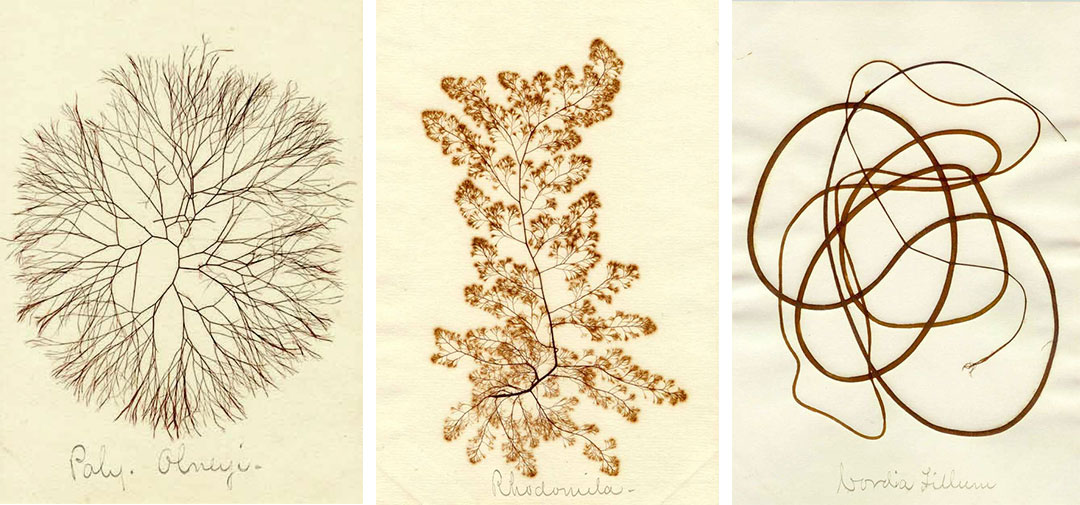
Three
pressed seaweed specimens were likely collected near Martha’s Vineyard,
Massachusetts, by Mary A. Robinson, circa 1885. Courtesy the Harvard
Botany Libraries.
As with other types of books during the period, customers could
choose whether to buy an album in the publisher’s boards (basic bindings
of stiff, pressed paper boards) and have it rebound to their own taste,
or buy a copy that had already been bound by a stationer or bookseller.
The Mary Carrington album is a mass-produced blank book that has been
specially bound, probably by the stationer before he sold it, and the
owner would have had her name applied to the cover after the purchase.
Collectors Weekly: When did seaweed collecting become popular?
 Massey:
Seaweed collecting began around the same time as scrapbooking, and
seems to have been most popular in Britain, though it was certainly
practiced in the U.S., as the Mary Carrington scrapbook attests.
Collecting natural-history specimens had already been a prestigious
hobby among gentlemen during the 17th and 18th centuries, and this
filtered down to the middle classes at the beginning of the 19th
century.
The Victorians
were passionate about collecting and organizing all aspects of the
natural world, from local seaweed and mosses to exotic birds. This was
connected to the development of science as an organized, professional
occupation; to the expansion of empire and trade; to Christian morality,
in which the study of nature was viewed as a way to gain a deeper
appreciation of God; and to the Romantic movement, which emphasized the
beauty and terror of nature.
The Victorians found thousands of ways to bring the natural world
into the domestic sphere, like with the display of taxidermied animals
or the incorporation of animal products and natural motifs into fashion
and home furnishings. One of the most interesting ways was through
drawing, another hobby for young ladies that was intended to put them in
touch with the natural world and the search for the “picturesque.” We
recently had two original drawings by
Charlotte Brontë, and I wrote a piece explaining how they fit with the
Victorian interest in the natural world and the need to provide young
women with productive hobbies.
Massey:
Seaweed collecting began around the same time as scrapbooking, and
seems to have been most popular in Britain, though it was certainly
practiced in the U.S., as the Mary Carrington scrapbook attests.
Collecting natural-history specimens had already been a prestigious
hobby among gentlemen during the 17th and 18th centuries, and this
filtered down to the middle classes at the beginning of the 19th
century.
The Victorians
were passionate about collecting and organizing all aspects of the
natural world, from local seaweed and mosses to exotic birds. This was
connected to the development of science as an organized, professional
occupation; to the expansion of empire and trade; to Christian morality,
in which the study of nature was viewed as a way to gain a deeper
appreciation of God; and to the Romantic movement, which emphasized the
beauty and terror of nature.
The Victorians found thousands of ways to bring the natural world
into the domestic sphere, like with the display of taxidermied animals
or the incorporation of animal products and natural motifs into fashion
and home furnishings. One of the most interesting ways was through
drawing, another hobby for young ladies that was intended to put them in
touch with the natural world and the search for the “picturesque.” We
recently had two original drawings by
Charlotte Brontë, and I wrote a piece explaining how they fit with the
Victorian interest in the natural world and the need to provide young
women with productive hobbies.

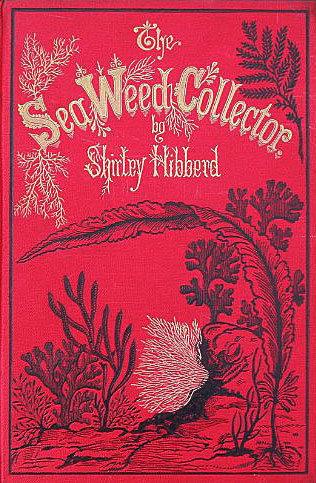
Shirley Hibberd’s “The Sea Weed Collector” from 1872 included vibrant illustrations of exotic underwater environments.
Both men and women participated in these cultural trends, and there
were definitely male seaweed collectors. In fact, Mary Carrington’s
album contains a calling card for a man named W. H. Gould onto which has
been placed a tiny seaweed specimen. But while male collectors were
able to join the ranks of the professional scientists, women were
largely restricted to domesticated versions of the same occupations.
They were encouraged to collect seaweed not as a scientific undertaking
but as a sentimental hobby and a social accomplishment.
Part of the appeal was what a seaweed collection said about the
collector. Anyone could appreciate and collect flowers, but
painstakingly obtaining, preserving, and mounting seaweed specimens
demonstrated patience, artistic talent, and the refined sensibilities
necessary to appreciate the more subtle beauties of nature. Queen
Victoria herself made a seaweed album as a young lady. I’ve searched all
over for Victoria’s album, but have been unable to locate it.

Many
collectors artfully arranged specimens or embellished them with
original drawings, as seen in these plates from Mary A. Robinson’s
album. Courtesy the Harvard Botany Libraries.
Collectors Weekly: How would someone actually press seaweed for display?

A press recommended by Shirley Hibberd in his 1872 book, “The Seaweed Collector.”
Massey: Harvard University’s library website has a good
description of the process taken from a late 19th-century guide to the
hobby. The seaweed was first cleaned in salt water and then placed on
the mounting paper, with the collector expected to trim “superfluous”
branches and arrange the specimen in an aesthetically pleasing fashion.
Next, the mounted specimens were layered between blotting paper and
pressed with up to 50 pounds of weight until they dried.
Under these conditions, seaweed exudes a gelatinous substance that
sticks it directly to the paper without the need for adhesives. We
believe that the same process was used for our album, as there is no
glue holding the specimens down.
Collectors Weekly: What about the smell?
Massey: As far as we’re aware, cleaning and pressing the
seaweed in this way removed much of the smell. The album we had in stock
had no odor, though I can’t say for certain whether this was due to the
mounting process or its age. The Victorian era was also a more pungent
time, so I suspect they either wouldn’t have been as bothered by the
smell or would have used one of their creative methods for minimizing
it.

Two
identification diagrams from David Landsborough’s “A Popular History of
British Seaweeds,” which was first published in 1849.
Collectors Weekly: When did seaweed collecting go out of style?
Massey: I’m not exactly sure when seaweed collecting went
out of fashion, but it was probably in the late 19th century as tastes
and fashions changed, and the Victorian mentality gave way to modernism.
I haven’t seen any scrapbooks or guide books dating past that time,
though of course it was probably still practiced by a small number of
people, and there may be hobbyists doing it today. But there certainly
wasn’t a decline in scrapbooking in general.
You might think that the social changes of the early 20th century,
such as the movement of women into the workforce, would have ended
scrapbooking’s popularity, but this wasn’t the case at all. In fact,
these changes gave women even more reasons to preserve ephemera, and
there are wonderful examples of scrapbooks from this period relating to
the suffrage movements, detailing women’s experiences during the First
and Second World Wars, and recording their working lives. We recently
had a great Jazz Age scrapbook that captured the excitement and uncertainty of that period for a young Midwestern woman.
Scrapbooking was still a popular hobby up through the last decade,
but we’ll have to see what happens as more of our paper ephemera becomes
digital. You might say that websites and applications such as Pinterest
and Evernote are the digital equivalents of 19th- and 20th-century
scrapbooks, but there is something to be said for a beautiful piece of
paper ephemera lovingly pasted into a blank book by hand.
Spectacular Seaweeds
(
For further information on seaweed collecting, see Laura Massey’s article on Mary Carrington’s seaweed album or the Harvard Botany Library’s post about Mary Robinson’s scrapbook. Historic books on seaweed include “Photographs of British Algae” by Anna Atkins, ”The Seaweed Collector” by Shirley Hibberd, “Sea Mosses” by A.B. Hervey, “British Seaweeds” by W.C. Johnstone and A. Croall, “British Marine Algae” by Henry Harvey, and “A Popular History of British Seaweeds” by D. Landsborough.)